Autonomous systems engineering.

Autonomyware is AI engineering for the whole system: AI systems engineering in which a team of engineering agents runs the complete process. Needs, requirements and concept of operations, decomposition into subsystems and components, verification at every gate, and one unbroken thread from every need to the part that meets it and the test that proves it.

  • Needs
  • Requirements
  • Concept of operations
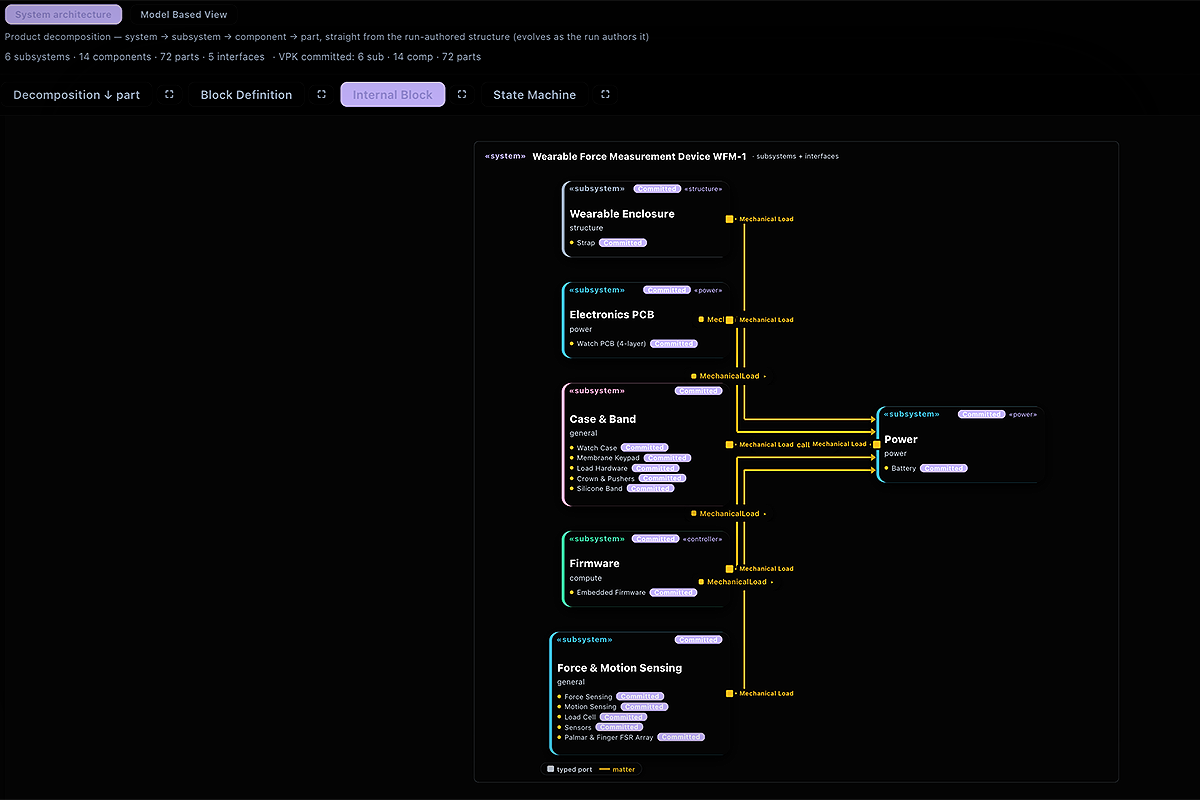
  • Architecture
  • V&V
  • Traceability

Follow one need all the way down, and back up.

Read from the engineering ledger of one product, a solar-powered EV charging station built from the prompt “create a solar powered EV charging station”. Every box is a real entry; titles and IDs are quoted as the app wrote them.

Promptcreate a solar powered EV charging station
Definition · decomposition
  1. L1AssumptionASSUMP-L1-A6GT-0002Site facilities managers are the primary day-to-day user1 of 33 assumptions
  2. L1User needUNEED-L1-A6GT-0002I need to see clear charging status at a glance1 of 20 user needs
  3. L1User requirementUREQ-L1-A6GT-0001Solar EV charging station shall present charging status at a glanceDisplay whether each charging point is ready, charging, or unavailable.1 of 22 user requirements
  4. L2System requirement · usabilitySYS-A6GT-0004Driver-facing charging status display shall remain readable in direct sunAcceptance: in a supervised site test, 3 status states are identified correctly in 9 of 9 trials using a human-factors observer checklist.1 of 69 system requirements
  5. L3Subsystem requirementSSR-A6GT-0028Status HMI and Daylight Display direct-sun readability across 1000 lx to 100000 lx1 of 1,744 subsystem requirements
  1. L3ComponentCOMP-A6GT-0020Daylight status HMI panelIn subsystem SUB-A6GT-0007, Status HMI and Daylight Display.1 of 2,629 components
Verification · validation
  1. L3Component testTEST-L3-A6GT-0001Daylight-readable status at 1.2 m under direct sunReady, charging and unavailable told apart by a parked driver at the bay face.
  2. L2Integration testINT-TEST-L2-A6GT-0001Daylight-to-session handoff within 10 sEnergy transfer starts within 10 s of a valid session request.
  3. L1ValidationVAL-L1-A6GT-0001First-time EV driver starts solar powered EV charging session without assistanceUsing the on-bay instructions and the connector only.

Concept to realization, one level at a time.

Every engineered prototype climbs the same levels, with a review at each gate and every decision kept in the ledger. The cards are read from the same EV charging station.

Solar-powered EV charging station · L1 assumptions33 written down, each one open to challenge
  1. ASSUMP-L1-A6GT-0001The initial buyer is a site owner adding solar EV charging capacity
  2. ASSUMP-L1-A6GT-0002Site facilities managers are the primary day-to-day user
  3. ASSUMP-L1-A6GT-0007The station is fixed outdoor equipment in a parking-lot environment
  4. ASSUMP-L1-A6GT-0016The station is expected to reach 99% session availability
  5. ASSUMP-L1-A6GT-0020The safety envelope assumes shock, arc, and crush hazards are contained
  6. ASSUMP-L1-A6GT-0027The certification path is self-declared first, then formal certification engineering
→ 20 user needs→ 22 user requirements→ 22 standards→ 5 concepts of operations

Assumptions, needs and requirements.

The prompt is read for who the product is for and what it must do. Every assumption is written down, so it can be challenged, and each one becomes needs and requirements. Concepts of operations, constraints and the standards that apply follow.

  • Chaincomment → assumption → need → requirement
  • Also at L1concepts of operations, constraints, standards, a first product image

Products built this way.

Real engineered prototypes from our workspaces, each started from a one-line request. Pick one and drag to turn it.

STRATA A200 autonomous terrain drilling robotAsked for an innovative drilling robot for autonomous terrain drilling.Drag to turn · scroll to zoom

Every decision, on record.

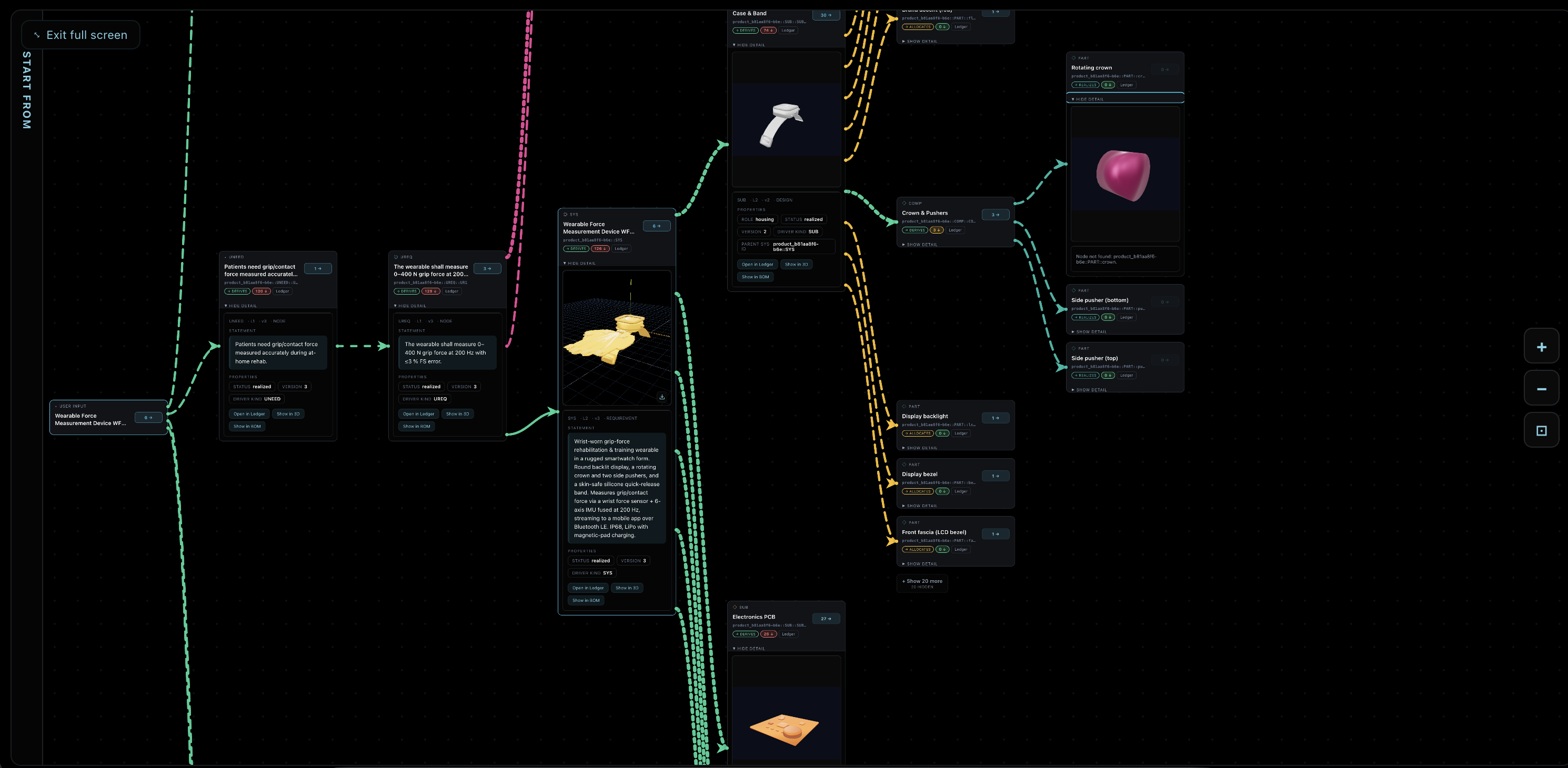
A traceability graph linking needs and requirements to parts

No siloed data. No gaps.

Every requirement traces back to the need and comment it came from, and forward to the parts and checks that satisfy it. Change one, and you see everything it touches.

  • Comment → assumption → need → requirement
  • Requirements linked to parts and tests
  • Change impact across the product
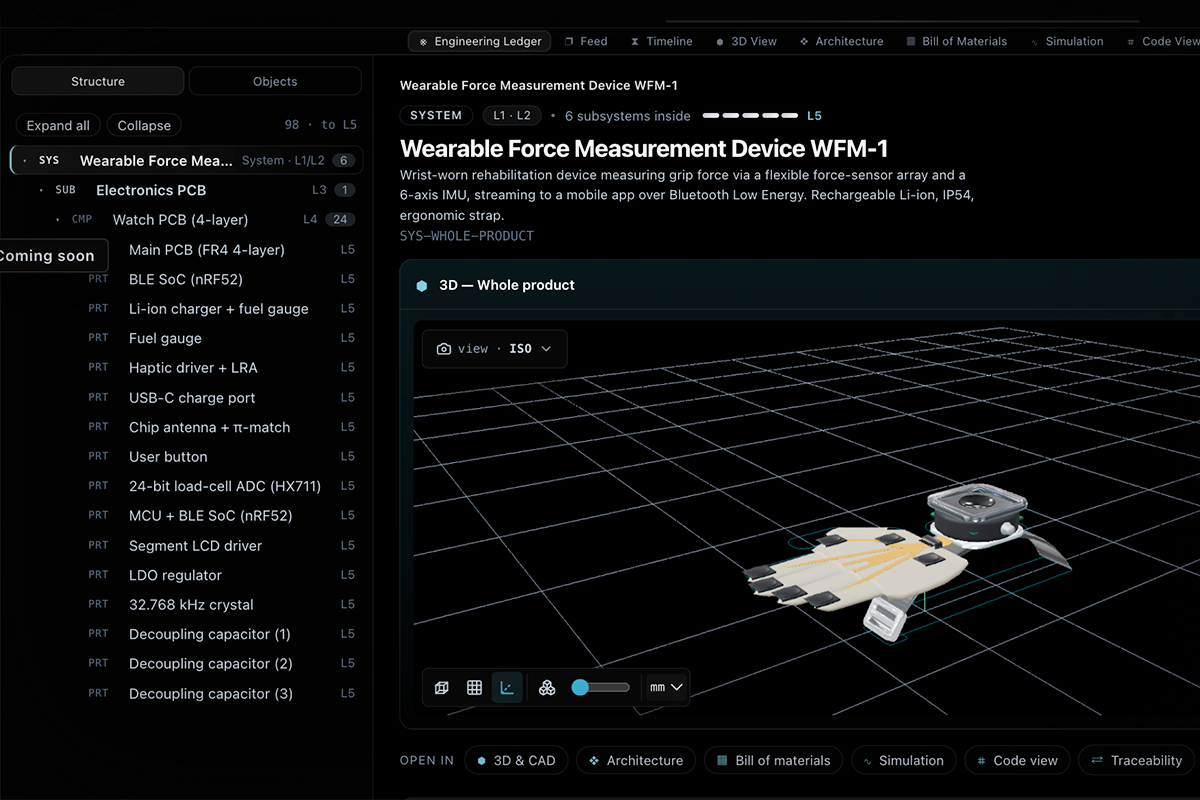
The engineering ledger of a wearable device with its structure and 3D model

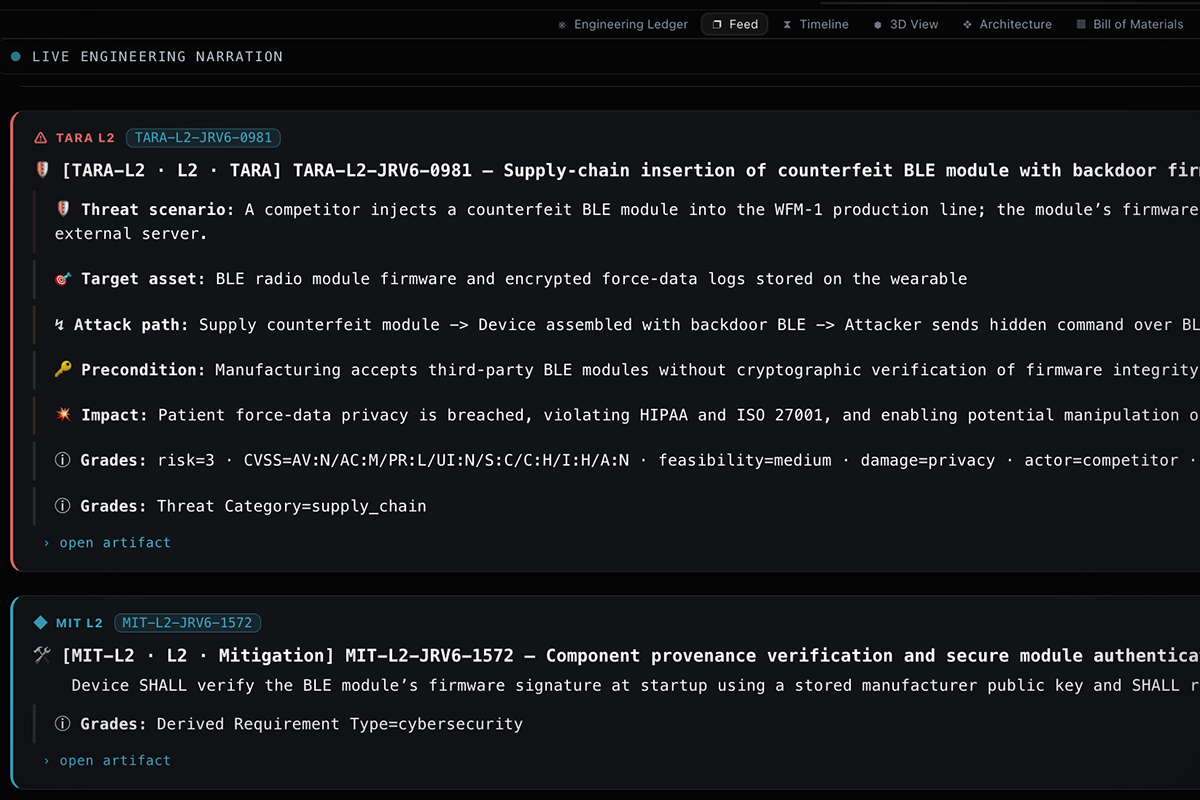
One record of every decision.

Structure, requirements, risks, the bill of materials, code and 3D live in one ledger, so anyone can see what was decided and why.

Watch the whole process.

The product film follows an EV charging station from need to realized product.

From one sentence to an engineered product

The product film: a turbofan, a drone across four versions, a dual-channel BLDC motor controller and a solar-powered EV charging station, all built in the app.

Watch on YouTube ↗

From idea to physical product

From a written prompt to sculpted figures and mechanical assemblies, through 3D inspection to manufacturing preparation.

Watch on YouTube ↗

Videos play from YouTube's privacy-enhanced player, only after you press play.